Thursday, 6 November 2014

Michael Haneke's : "Funny Games" (1997) - The violence of power

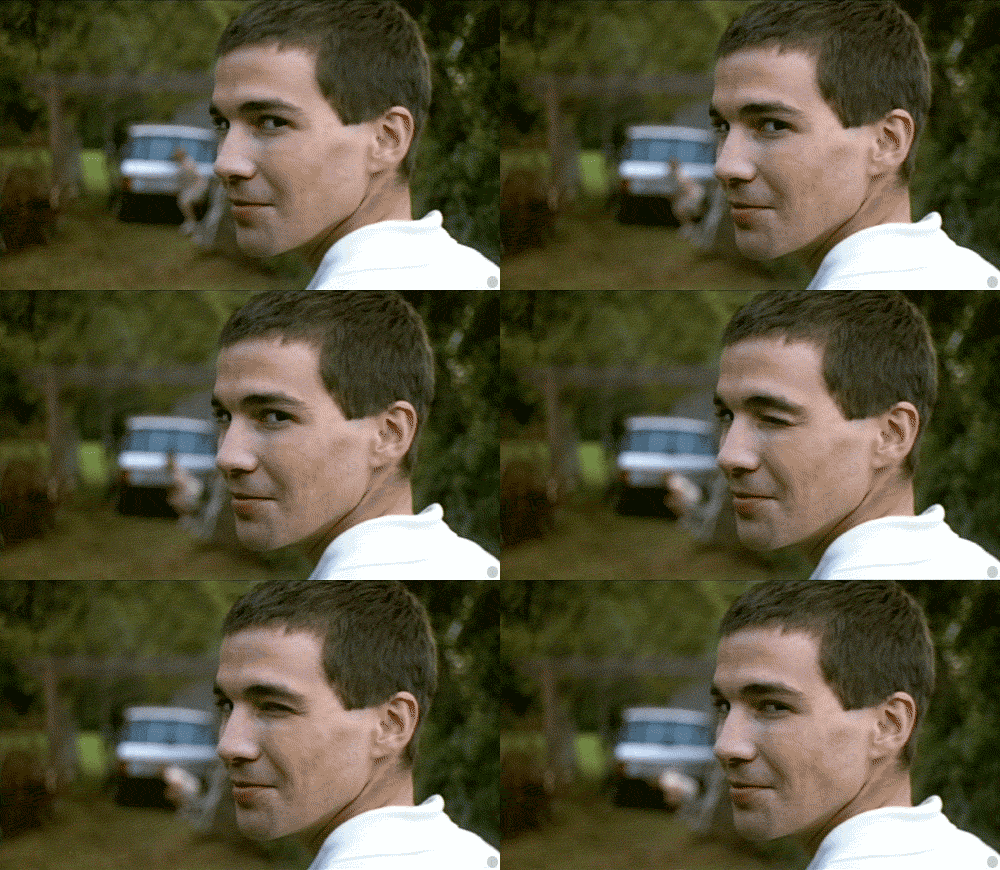
Ahh... Aerial shots of a family car on a sunny day, probably taking their boat to a lakeside cabin somewhere to spend the weekend. Hendel is playing on the CD player while the couple and their kid play a song-guessing game, and we are comfy in our chairs, probably wondering when is it that we are going to be able to do the same. The mood is tranquil, and peaceful.


And then this.

(If you didn't finish the clip you probably don't understand why this is one of my favourite opening sequences of all time. Go ahead, finish it, you'll like it.)

(I promise.)

The opening sequence does a great job at foreshadowing what is to come for the next hour-and-a-half or so. We are shown things that indicate happiness, peace, an almost unbearable level of innocence, only for them to be smashed to bits by a cruelty that feasts on the mood that preceded it. That contrast between the good and the perverse is key to the emotional roller coaster that is this film. And boy, after a few bumps, this one only goes down. 

I wont go down to specifics, since the purpose of this blog is only to recommend films, not spoil them, but if there is one thing that keeps bringing me back to this one is the fact that the most brutal scenes, the most violent ones, don't involve physical violence. Sure, there is some of that too, but there is something truly unsettling about seeing a person on the losing side of a power struggle, completely helpless and at the mercy of someone else's whims.  

Just like in the opening sequence, when the happy roadtrip scene is suddenly invaded by the screams and banging of hard heavy metal, that cannot be changed nor stopped, there is a force that will invade the life of the family we are introduced to, a force with unusually good manners, soothing voices, and wearing white. 

I wont go on, as i might already be saying to much about the film, but i have to say that it isn't strictly conventional in the sense that the objectives and motives of the characters aren't always clear, and we as an audience become more involved in the situation than we would perhaps feel comfortable with. But that's the beauty of it. The power relationships within the film start involving us aswell. 


(You will be delightfully dissapointed.)

(P.S. Try siding with both the protagonists and antagonists throughout the film, I think it is essential to the whole experience) 


Sunday, 8 June 2014

Le fabuleux destin d'Amélie Poulain

"Amelie has a strange feeling of absolute harmony. It's a perfect moment. A soft light, a scent in the air, the quiet murmur of the city. A surge of love, an urge to help mankind overcomes her."
If you're looking to restore your faith in humanity and all that is good, fall in love, and remember what hearty chuckles felt like, 120 minutes might be all you need. 

If you're anything like me, you wont know how to feel about the film once its ended. I couldn't understand how a love story made my insides turn into a warm cuddly adorable mess. What ever happened to the modern elegance of apathetic love, cigarettes, and the urban comfort of carbon monoxide? Existentialist angst and pessimism have to be cooler than mere happiness, right? RIGHT?!


(Awesome facial hair never lies goddammit.)

Well, wrong. Jean-Pierre Jeunet manages to bring out the inner idealistic child we've all left behind in some long lost corner of our mind and never bothered to go back for. And he isn't even mad at you. Just like your inner child, Amélie (the protagonist) is rather detached from the world, she is unpolluted from modern paranoia, mistrust and skepticism, which makes her pure in essence. The whole film, seems to express this same detachment from the negative aspects that so strongly shape contemporary reality, and takes us back to a Belle Epoque in modern day Paris. 

The soundtrack throughout the film, for example, are all Parisian Folk compositions by Yann Tiersen. This genre was born at the start of the XX century in Paris, a time where it was the home of the bohème, where poor artists congregated in cafés like the Chat Noir or the Lapin Agile to talk big, and new inventions arose daily. Certainly a time of hope and experimentation. The music transmits that Belle Epoque aura that resonates on the imagery which many people like myself grew up with when reading or hearing about Paris.


The colours in the film are highly saturated and have a rather yellowish hue to them. Showing a preference for warmth rather than coldness. This proposal is obviously trying to paint a different reality than the one our plain eyes see. We experience the images through a different lens, a lens pertaining to a different time, and a different feeling towards the world.


The music, the colours and Amélie herself, are in dissonance with the reality she lives in (1997 Paris) And that is what makes the film so powerful. Through the colours and music we experiment reality as she decides to live it, idyllically. After two hours I didn't want to leave her world, I wanted to go out and paint reality slightly yellow, learn to play the accordion, and finally tell the woman I loved that indeed, I did. 

And so, the film becomes a testament to kindness and hope in modern times. And a reminder that love isn't a dream, or a fantasy, it is merely an action.

Monday, 2 June 2014

Eye Candy

"Strangers shouldnt talk to little girls."
Hard Candy was perhaps the first movie I fell in love with. Not only was it strikingly beautiful, (props to Ellen Page's mojo working on my teenage hormones) it also told a compelling story about a minor taking control of the world that surrounded her, and justice into her own hands.

Im going to try and talk very little about the plot itself, because you mightn't have seen the film before, and I intend to keep these posts spoiler free. Because I care about you and your film-watching experience. 

One thing I will talk about though, is colour. A rather sober, minimalistic use of colour in this film ends up producing a distinct visual signature. The subtle changes in saturation, brightness and temperature of this rather simple array of colours take us through the whole range of emotional atmospheres. 

From warm, tender cuteness:


To cold hostility:

(Cold hostile cuteness)

The colours express and accentuate the emotions that the actors convey, and are a way for us to enter the emotional subjectivity of the characters. At points it is also used as a foreshadowing element, but ill let you see that for yourself.

*To all of you Analog lovers out there, please contain your orgasms* The colouring for the film was done in the laboratory (over the film negative itself) instead of working over digital video with an editing program. Which means that the colourist, Jean-Clement Soret, had to scan the whole film frame by frame using a digital intermediate program, edit the colours and then taking the film to the laboratory so that the colours could be altered. 

(Pictured: God)

Being a psychological thriller, the film does a great job of keeping the suspense alive throughout, raising many questions about the motives and truthfulness of the characters, and not hinting any obvious answers. You are always engaged trying to solve these questions, begging for the camera to give you a hint of the reality beyond the tightly enclosed frames. 

With unwaveringly intense performances by Ellen Page and Patrick Wilson, a narrative that will keep you guessing right until the last frame, and stunning visual beauty, Hard Candy is certainly a must-watch.

Sunday, 1 June 2014

Opening credits.

Hello there, my name is Kenzo, and this is a blog which will be completely devoted to that which I love most, Film. The objective is basically to share my favourite must-watch films with you, you beautiful reader, and to show you why they totally kick filmic ass. Enjoy.


Yup.